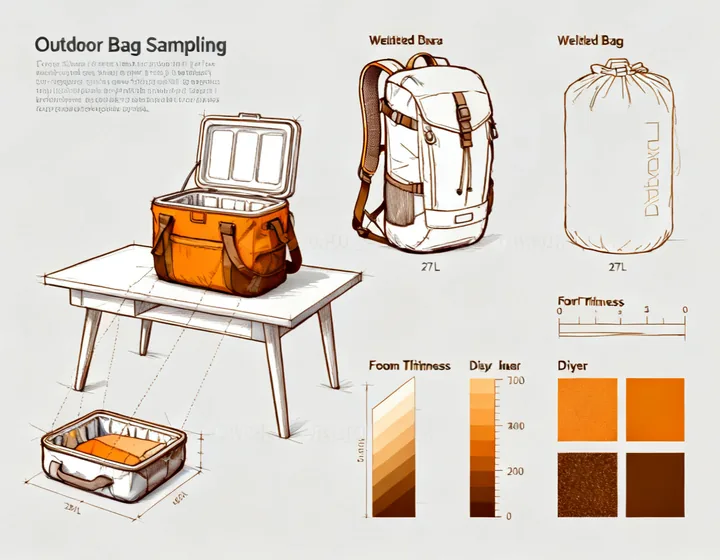
Name litre band, foam thickness and channel on the RFQ. Stock quotes in 1 business day; OEM proposals in 5.
Illustration of Yeti cooler bag sampling and specification review
Guided pack services

Yeti services that compare stock cooler bags with OEM insulated runs

Category teams often arrive with a mixed request: a soft cooler backpack for grocery-to-trail retail, a 27L travel last for wholesale, and a private-label colorway that is not yet sampled. This page walks through how Yeti separates those jobs so sampling, MOQ and documentation do not collapse into one vague quote.

Two-column service cards

Four desks that keep cooler-bag programs reviewable

Each card is a workstream with a deliverable. The intent is to give buyers a path they can brief internally, rather than a list of slogans about support. Insulated SKUs and uninsulated travel lasts do not share a sampling clock because foam die-cuts add days.

Assortment mapping

Soft coolers 12-30 L, Crossroads-class travel 22-35 L, duffels 40-90 L and welded dry packs are plotted against channel and price architecture. The output is a capacity-and-insulation matrix, not a longer SKU dump. Buyers who mix a 25L Cayo daypack with an M20 cooler receive a split recommendation because the constructions do not share a liner path.

Sample and material review

Fabric denier, PU coating, hydrostatic-head row, zipper gauge, foam thickness and liner weld are checked against the stated activity. A cooler backpack sample is judged on leak checks at the zipper and corner welds; a 27L travel sample is judged on lockable zipper travel and base abrasion. Those notes are written so quality and merchandising can read the same file.

Inspection planning

Nine stitch checkpoints plus four leak points are assigned before bulk confirmation. Haul loops dominate duffels; foam compression and zipper-tape adhesion dominate coolers. If a buyer asks for lifetime-sounding retail language, the inspection plan still lists exclusions for ice-melt staining, chemical cleaners and undocumented printing.

Channel documentation

Retail needs hangtag-safe claims that do not call a PU coat waterproof. Wholesale needs carton cube and replenishment notes. OEM needs logo placement, color approval and MOQ. Yeti prepares the matching file set so a club equipment manager and a national buyer are not handed the same paragraph.

Embedded service FAQ

Decision points that change sampling time and MOQ

These questions sit here, not only on the homepage, because they alter the service path. A stock replenishment and a private-label insulated colorway cannot share the same 1-day quote clock. Foam die-cuts and liner welds add calendar days that a 420D travel last does not need.

After the construction brief is frozen, Yeti targets a written OEM proposal within 5 business days. Physical foam die-cuts and liner weld samples follow the approved BOM; they are not shipped against an incomplete logo file. Insulated samples typically leave in 15-20 working days. Uninsulated travel lasts stay closer to 12-18 working days. Stock SKUs stay on the 1-business-day quote path.

Small heat-transfer marks on a documented print zone can stay on the existing inspection matrix. Full-panel sublimation on TPU, a new zipper color, or a changed foam thickness resets leak and colorfastness checks. Undocumented aftermarket presses are outside the repair program. Screen print belongs on 600D overlays, not on a welded Panga face.

ISO 9001:2015 workflow notes, amfori BSCI audit readiness, OEKO-TEX STANDARD 100 textile references, hydrostatic-head rows for PU-coated bodies, and the leak-check map for insulated SKUs. Compliance dossiers are targeted within 3 business days when the product type and destination market are stated. Welded dry bags do not inherit a millimetre hydrostatic-head claim from a PU daypack.
Before / after comparison

What changes when a Yeti request moves from stock to OEM

Before: stock wholesale

Frozen BOM, published capacity, 1-day quote target

  • Existing denier, zipper gauge and foam thickness
  • Repair exclusions already on the SKU file
  • No new color approval loop
  • Suitable for replenishment and club reorders
After: private-label OEM

New print, trim or foam, 5-day proposal, MOQ reset

  • Logo placement, hangtag and carton marks enter the brief
  • Foam lot and liner film must be re-tested if swapped
  • Inspection matrix updated for print and leak points
  • Lead time follows sample approval, not catalog availability

A common failure mode is treating OEM as a sticker on a stock cooler. If the print method, foam lot or zipper color changes, Yeti treats it as a new construction record even when the silhouette looks familiar on a photo. That is the stock-wholesale versus private-label OEM dispute in one sentence, and it is why the clocks differ.

Start a service review

Tell Yeti which path you need: stock, mixed assortment or OEM.

Include activity, capacity band, foam need, annual quantity, destination market and required files. The pack desk will answer with the matching sampling clock and inspection notes.

Please enter your name.
Please enter a valid email.
Please add your company name.
Please add the destination country.
Please choose a product type.
Please choose a channel.

Stock items: quote within 1 business day. Custom / OEM projects: full proposal within 5 business days. Compliance documentation requests: dossier within 3 business days.